
How Blood is Made
Understanding how blood cells are produced helps you make sense of your diagnosis and treatment options.
What is Hematopoiesis?
Hematopoiesis (hee-mat-oh-poy-EE-sis) is the process by which your body makes new blood cells. This happens primarily in your bone marrow—the soft, spongy tissue inside your bones.
Stem Cells: The Factory Workers
At the heart of blood production are hematopoietic stem cells. These remarkable cells can:
- Self-renew: Make copies of themselves to keep the factory running
- Differentiate: Transform into any type of blood cell your body needs
Blood Cell Differentiation (Hematopoiesis)
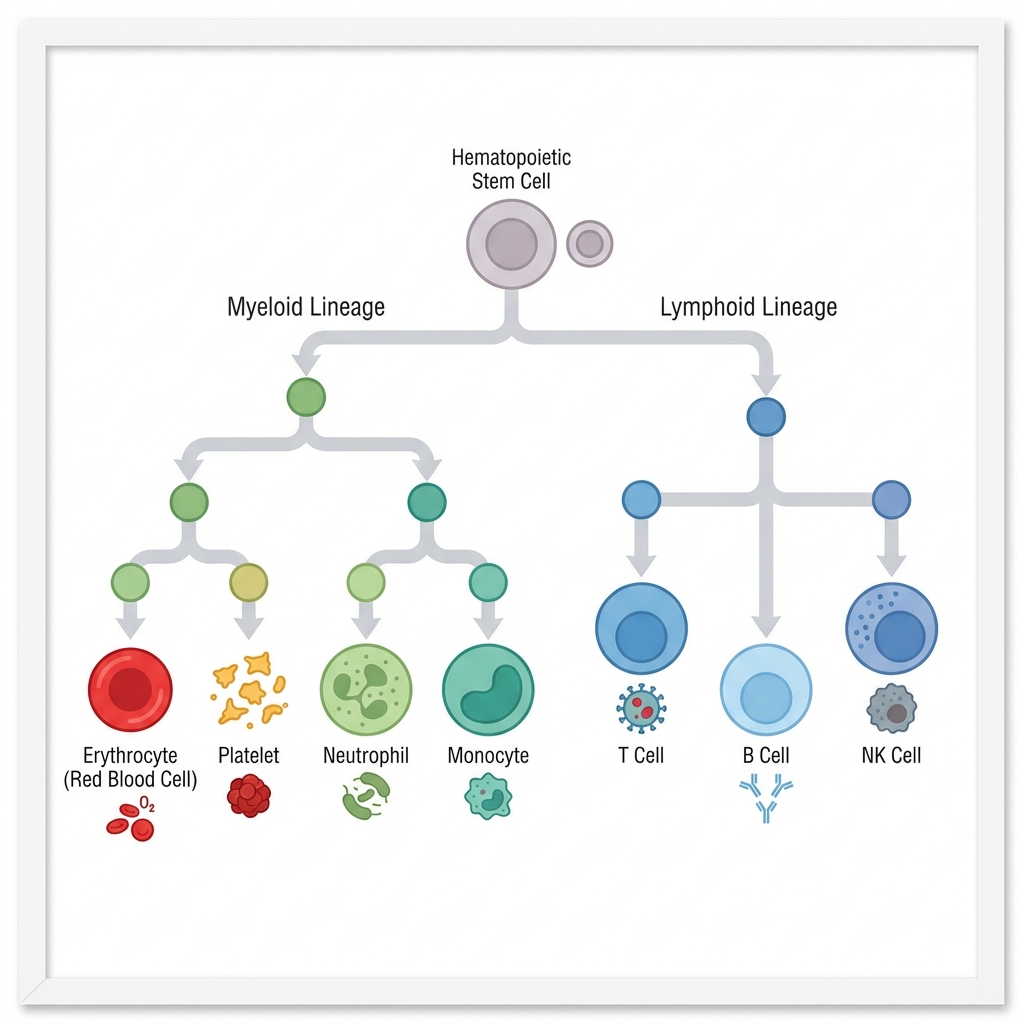
Starting from a single hematopoietic stem cell, blood cells differentiate into two main lineages: myeloid (red cells, platelets, neutrophils, monocytes) and lymphoid (T cells, B cells, NK cells).
The Three Types of Blood Cells
🔴 Red Blood Cells
Carry oxygen from your lungs to all parts of your body. Low levels cause fatigue and shortness of breath.
⚪ White Blood Cells
Fight infections and disease. Low levels increase your risk of infections.
🟣 Platelets
Help your blood clot to stop bleeding. Low levels can cause easy bruising and bleeding.
What Goes Wrong in Blood Cancer?
Normal stem cells form healthy blood cells such as red and white cells and platelets. AML starts with a mutation in the DNA of a single stem cell in the bone marrow. This changed cell becomes a leukemic cell and multiplies into billions of cells called leukemic blasts.
Leukemic blasts:
- Do not function normally
- Block the production of normal cells
- Grow and survive better than normal cells
As a result, the number of healthy blood cells is usually lower than normal, and can result in the following conditions:
- Anemia: a low number of red cells in the blood, causing fatigue and shortness of breath
- Neutropenia: a low number of neutrophils (a type of white blood cell), preventing the immune system from effectively guarding against infection
- Thrombocytopenia: a low number of platelets, causing bleeding and easy bruising
- Pancytopenia: low numbers of all three blood cell types
📚 Learn More
Blood Cancer United provides detailed resources about blood cell production and blood cancers.
Understanding Blood Cancer at Blood Cancer UnitedThe Two Main Cell Lineages
Blood cells develop along two main pathways, called lineages. Understanding which lineage is affected helps doctors classify your leukemia:
🔶 Myeloid Lineage
Produces red blood cells, platelets, and most white blood cells (neutrophils, monocytes, eosinophils, basophils).
Affected in AML (Acute Myeloid Leukemia) and CML (Chronic Myeloid Leukemia).
🔷 Lymphoid Lineage
Produces lymphocytes (B cells, T cells, and NK cells), which are key players in your immune system.
Affected in ALL (Acute Lymphoblastic Leukemia) and CLL (Chronic Lymphocytic Leukemia).
Bone Marrow Tests: What to Expect
To understand what's happening in your blood cell factory, doctors need to examine your bone marrow directly. These tests help diagnose leukemia and monitor treatment.
🩺 Bone Marrow Aspirate
A thin needle extracts liquid marrow containing cells. This sample is used for genetic testing, flow cytometry, and microscopic examination. The procedure takes about 15-20 minutes and is usually done from the back of your hip bone.
🦴 Bone Marrow Biopsy
A slightly larger needle removes a small core of solid bone and marrow tissue. This allows doctors to see how cells are arranged and how full the marrow is with cells (cellularity). Often done together with the aspirate.
Common Blood Count Terms
When you receive lab results, you'll see terms like these. Here's what they mean:
| Term | What It Measures |
|---|---|
| CBC | Complete Blood Count - the overall blood test panel |
| WBC | White Blood Cell count - your infection fighters |
| ANC | Absolute Neutrophil Count - a key indicator of infection risk |
| Hgb / Hb | Hemoglobin - the oxygen-carrying protein in red blood cells |
| Hct | Hematocrit - percentage of blood volume that is red blood cells |
| PLT | Platelet count - cells that help your blood clot |
💡 Tip: Track Your Counts
Ask your care team for copies of your lab results. Keeping a simple log of your WBC, ANC, hemoglobin, and platelets can help you understand your treatment progress and know when to be extra careful about infections.