
ℹ️ What is Monoclonal Gammopathy of Undetermined Significance (MGUS)?
💊 Primary Treatment Approaches
🔬 Understanding MGUS
MGUS is not cancer. It is a precursor condition in which a small clone of abnormal plasma cells produces a detectable monoclonal protein (M-protein) in the blood, but at levels too low to cause symptoms or organ damage. MGUS is remarkably common — present in ~3-4% of adults over 50 and ~5% over 70.
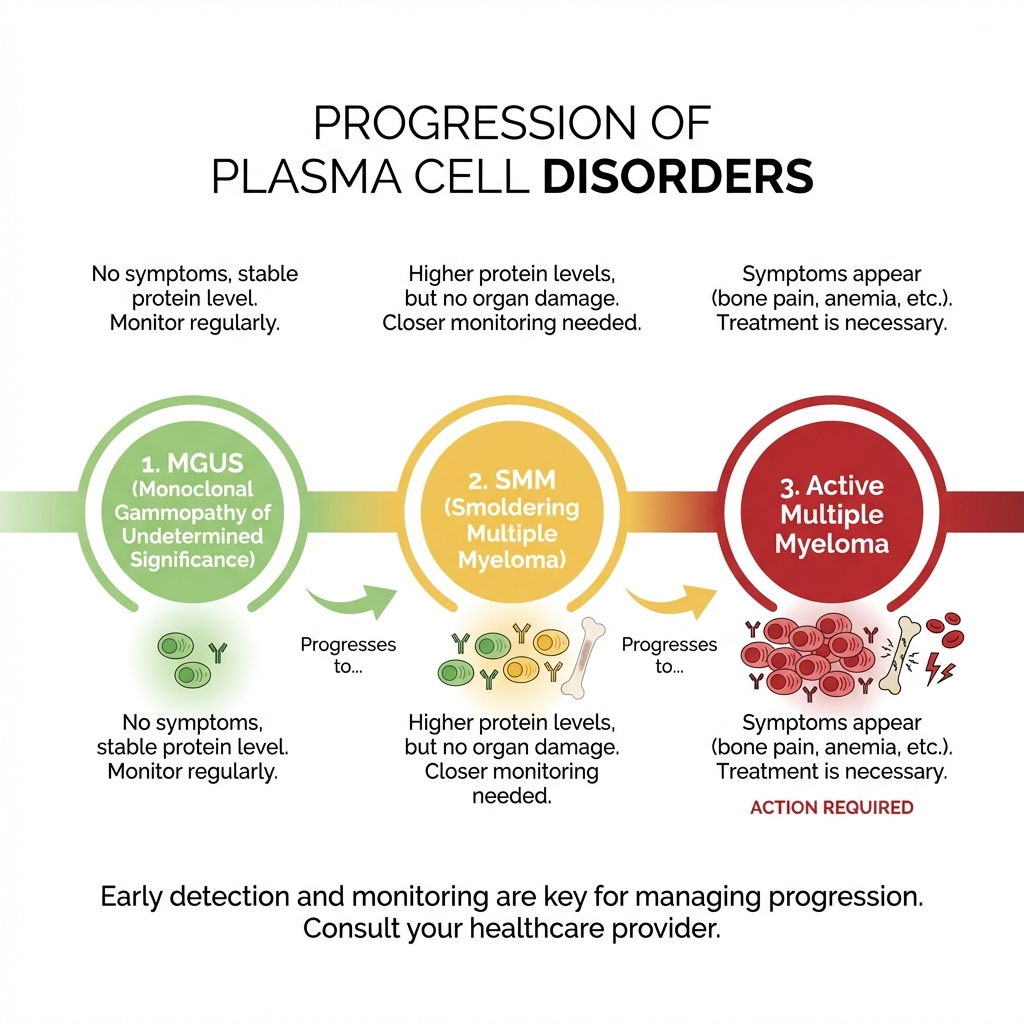
Figure 1: The spectrum of plasma cell disorders. MGUS is the earliest pre-malignant stage on this pathway.
📊 Diagnostic Criteria
- • M-protein <3 g/dL in serum
- • Bone marrow plasma cells <10%
- • No CRAB criteria (no organ damage)
- • No myeloma-defining events
📈 Progression Risk
- • ~1% per year risk of progressing to myeloma or related malignancy
- • Risk persists indefinitely — never "safe" to stop monitoring
- • After 25 years: ~25% cumulative progression
- • Most MGUS patients never progress
🔍 Risk Stratification
Three risk factors predict progression:
- • Non-IgG isotype (IgA, IgM)
- • M-protein ≥1.5 g/dL
- • Abnormal free light chain ratio
0 risk factors: ~5% progression at 20yr
3 risk factors: ~58% progression at 20yr
📋 Types of MGUS
Not all MGUS is the same. The type of M-protein determines what the MGUS could potentially evolve into:
Non-IgM MGUS (IgG, IgA, IgD)
The most common type (~85%). Can progress to multiple myeloma or, rarely, AL amyloidosis. IgG MGUS has the lowest risk of progression among all isotypes.
IgM MGUS
~15% of MGUS. Can progress to Waldenström's macroglobulinemia (lymphoplasmacytic lymphoma) rather than myeloma. IgM MGUS has distinct biology — the clonal cells are lymphoplasmacytic rather than classic plasma cells.
Light Chain MGUS
A newer entity where only free light chains (kappa or lambda) are produced without an intact immunoglobulin. Can progress to light chain myeloma or AL amyloidosis. Detected by serum free light chain assay rather than SPEP.
🩺 Monitoring & Living with MGUS
MGUS requires no treatment — only monitoring. The goal is to detect progression early, when intervention is most effective.
📅 Monitoring Schedule
- • Low risk: repeat labs at 6 months, then every 2-3 years if stable
- • Intermediate/High risk: labs every 6-12 months
- • Key labs: SPEP, serum free light chains, CBC, creatinine, calcium
- • Report new symptoms immediately: bone pain, fatigue, recurrent infections, unexplained weight loss, numbness/tingling
💡 Beyond Myeloma: Other MGUS-Related Conditions
MGUS can cause problems even without progressing to myeloma: peripheral neuropathy(~5% of MGUS patients), kidney disease (monoclonal gammopathy of renal significance — MGRS), osteoporosis, and increased infection risk. These "MGUS-associated" conditions may warrant treatment even without myeloma progression.
📚 MGUS Resources
🛠️ Tools & Focused Research
Scientific Literature
Search thousands of PubMed articles curated for MGUS.
Clinical Trials
Explore actively recruiting clinical trials for this disease group.
View Clinical Trials