
ℹ️ What are Myelodysplastic Syndromes (MDS)?
💊 Primary Treatment Approaches
MDS treatment is risk-adapted — ranging from supportive care for lower-risk disease to disease-modifying therapies and transplant for higher-risk MDS:
🔬 Ineffective Hematopoiesis — The Core Problem
MDS is fundamentally different from most cancers. Rather than cells growing out of control, the hallmark of MDS is ineffective hematopoiesis — the bone marrow is active (often hypercellular) but produces defective blood cells that die before they mature. This paradox — a busy marrow but low blood counts — is the defining feature of the disease.
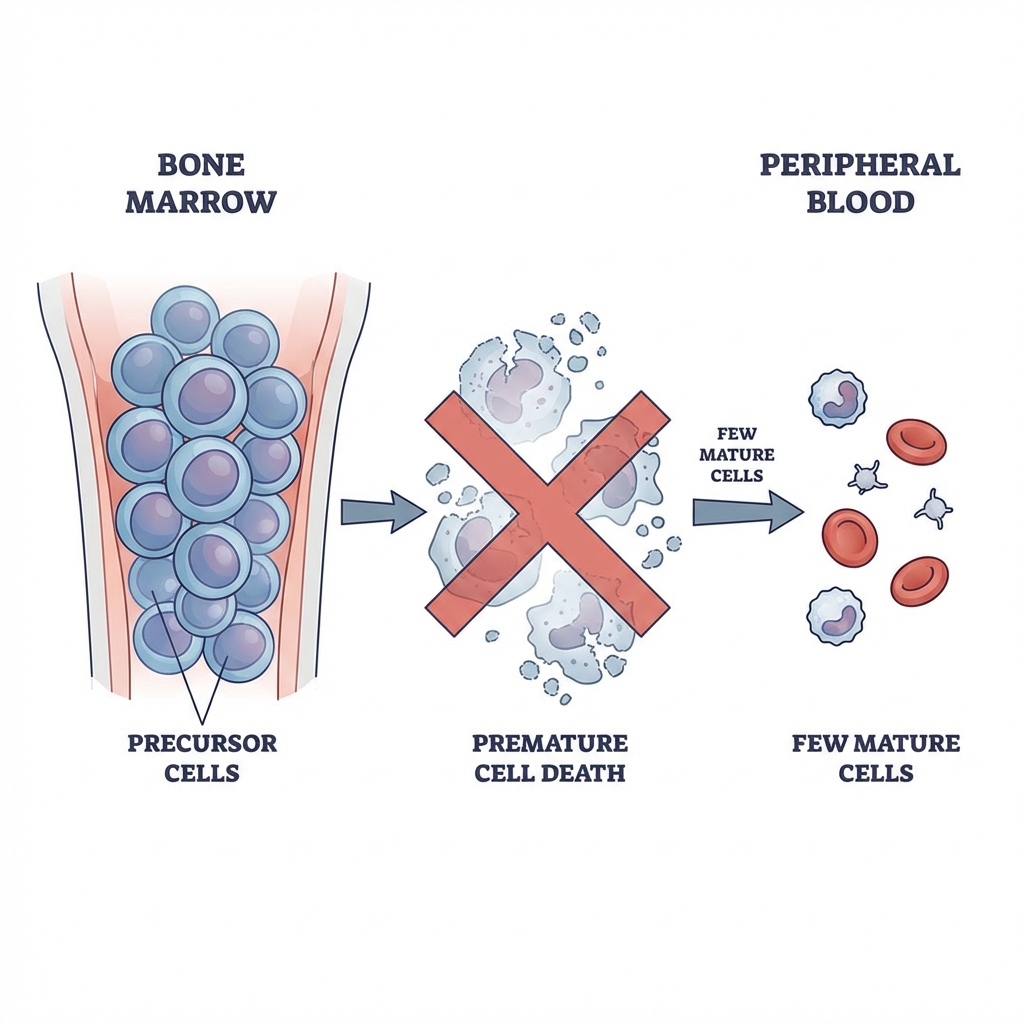
Figure 1: Ineffective hematopoiesis. Precursor cells in the marrow fail to mature and undergo premature death (apoptosis), leading to low counts in the blood.
🩸 Red Blood Cells
Anemia is the most common presentation, affecting ~80-90% of MDS patients.
- • Fatigue, weakness, shortness of breath
- • Dysplastic features: ring sideroblasts, multinucleated erythroid precursors, megaloblastic changes
- • Many patients become transfusion dependent
🛡️ White Blood Cells
Neutropenia and dysfunctional granulocytes increase infection risk.
- • Hypolobulated or hypogranular neutrophils ("pseudo-Pelger-Huët")
- • Impaired bactericidal function even at normal counts
- • Infections are a leading cause of death in MDS
🩹 Platelets
Thrombocytopenia causes bleeding risk in ~40-60% of patients.
- • Large, abnormal platelets with poor function
- • Micromegakaryocytes (abnormally small megakaryocytes in marrow)
- • Bruising, petechiae, mucosal bleeding
💡 Why "Syndromes" (Plural)?
MDS is not a single disease but a heterogeneous group of disorders ranging from indolent conditions with isolated anemia (survival >10 years) to aggressive forms with excess blasts that behave nearly like AML (survival <1 year). The plural "syndromes" reflects this enormous clinical variability — treatment decisions are heavily individualized.
📋 MDS Classification (WHO 2022 / ICC)
The 2022 WHO and ICC classifications revised MDS extensively. Key subtypes are defined by blast percentage, lineage dysplasia, cytogenetics, and specific genetic mutations. Some subtypes are now defined primarily by their genetics rather than morphology alone.
Key MDS Subtypes
MDS with Low Blasts (MDS-LB)
Blasts <5% in marrow. Includes single-lineage and multi-lineage dysplasia. This is the most common MDS subtype. Patients may live years with supportive care alone, but quality of life is often impacted by transfusion dependence and fatigue.
MDS with Ring Sideroblasts (MDS-RS)
Characterized by ≥15% ring sideroblasts (or ≥5% with an SF3B1 mutation). Ring sideroblasts are red cell precursors with iron-laden mitochondria ringing the nucleus — visible on Prussian blue stain. SF3B1-mutated MDS has the best prognosis of any MDS subtype and responds well to luspatercept.
MDS with Increased Blasts (MDS-IB)
MDS-IB1: 5-9% marrow blasts. MDS-IB2: 10-19% marrow blasts. Higher blast counts indicate increasing risk of AML transformation. MDS-IB2 is sometimes treated similarly to AML, especially in younger/fit patients.
MDS with Biallelic TP53 Inactivation (MDS-biTP53)
A newly defined entity in 2022. Patients with two TP53 hits (mutation + deletion, or two mutations) have an extremely poor prognosis regardless of blast count — median survival ~9 months. Often associated with complex karyotype and therapy-related MDS. Standard therapies have limited efficacy; clinical trials are strongly recommended.
MDS with Isolated del(5q)
Defined by an isolated deletion of the long arm of chromosome 5. Predominantly affects older women. Presents with macrocytic anemia and often normal or increased platelet counts. Uniquely responsive to lenalidomide — ~67% achieve transfusion independence, and ~45% achieve cytogenetic remission.
🧬 The Molecular Landscape of MDS
Next-generation sequencing has revealed that MDS is driven by recurrent somatic mutationsin a relatively small set of genes. These mutations fall into distinct functional categories and often co-occur in predictable patterns.
🧪 RNA Splicing Genes (~60% of MDS)
The most frequently mutated pathway in MDS. These mutations cause global splicing abnormalities, producing dysfunctional proteins across many genes:
- • SF3B1 (~25-30%) — associated with ring sideroblasts and favorable prognosis
- • SRSF2 (~10-15%) — often co-occurs with TET2; associated with intermediate/poor prognosis
- • U2AF1 (~8-10%) — associated with del(20q) and higher risk of AML transformation
- • ZRSR2 (~5%) — X-linked; more common in males
Splicing mutations are mutually exclusive — only one is present per patient — suggesting they affect overlapping pathways.
🔄 Epigenetic Regulators (~50%)
These genes control DNA methylation and chromatin modification — how genes are turned on and off:
- • TET2 (~20-25%) — DNA demethylation; loss causes hypermethylation of tumor suppressors
- • DNMT3A (~10-15%) — DNA methyltransferase; one of the earliest mutations in clonal hematopoiesis
- • IDH1/2 (~5%) — produces oncometabolite 2-HG; targetable with ivosidenib/enasidenib
- • ASXL1 (~15-20%) — chromatin modifier; associated with adverse prognosis
- • EZH2 (~5%) — polycomb repressive complex; loss-of-function in MDS
Hypomethylating agents (azacitidine, decitabine) work by reversing the abnormal DNA methylation caused by these mutations — explaining why they are effective even without specific molecular targeting.
⚠️ Tumor Suppressors & Signaling
- • TP53 (~8-10%) — biallelic inactivation defines a distinct, high-risk subtype. Associated with complex karyotype and therapy-related MDS
- • RUNX1 (~10%) — transcription factor critical for hematopoiesis; mutations increase AML transformation risk
- • STAG2, RAD21 — cohesin complex components; affect chromosome segregation and gene regulation
- • NRAS, KRAS, CBL — RAS pathway activation; often acquired during disease progression
📊 CHIP → CCUS → MDS: The Clonal Continuum
MDS often evolves from precursor states: CHIP (Clonal Hematopoiesis of Indeterminate Potential) — mutations detected without any blood count abnormalities, present in ~10% of adults >65 — may progress to CCUS (Clonal Cytopenia of Undetermined Significance) when mild cytopenias appear, and eventually to overt MDS. The mutations driving CHIP (TET2, DNMT3A, ASXL1) are the same founders of MDS, supporting a model of stepwise clonal evolution.
📊 Risk Stratification — IPSS-R & IPSS-M
Because MDS ranges from indolent to aggressive, risk stratification is the most important step in treatment planning. Two main scoring systems are used:
IPSS-R (Revised International Prognostic Scoring System)
The established standard, using 5 clinical variables:
| Variable | What It Measures |
|---|---|
| Cytogenetics | Chromosomal abnormalities (5 risk groups) |
| Bone marrow blasts | Percentage of immature cells (0-2%, 2-5%, 5-10%, >10%) |
| Hemoglobin | Severity of anemia |
| Platelet count | Severity of thrombocytopenia |
| ANC | Absolute neutrophil count (infection risk) |
Produces 5 risk categories: Very Low, Low, Intermediate, High, Very High.
IPSS-M (Molecular International Prognostic Scoring System)
Published in 2022, IPSS-M incorporates gene mutations alongside the IPSS-R variables. It includes mutations in 31 genes and produces a 6-category riskstratification. Key improvements:
- • ~46% of patients are reclassified compared to IPSS-R — many to higher or lower risk
- • SF3B1 mutations lower the risk score (favorable)
- • TP53 multi-hit, RUNX1, ASXL1, EZH2, NRAS increase the risk score (adverse)
- • Available as a free online calculator at MDS-Foundation.org
Lower-Risk MDS
IPSS-R Very Low / Low / some Intermediate
Focus: quality of life, transfusion support, ESAs, luspatercept, lenalidomide (del(5q))
Higher-Risk MDS
IPSS-R High / Very High / some Intermediate
Focus: disease modification, HMAs (azacitidine), transplant evaluation, clinical trials
💊 The Treatment Landscape
MDS treatment is uniquely risk-adapted. Unlike most cancers where treatment aims to eliminate the disease, lower-risk MDS is often managed with supportive care and symptom relief, while higher-risk MDS is treated more aggressively to delay AML transformation.
🩸 Supportive Care & Lower-Risk Therapies
Red Blood Cell Transfusions
The cornerstone of symptomatic management. However, chronic transfusions lead to iron overload (hemochromatosis), which damages the heart, liver, and endocrine organs. Iron chelation (deferasirox) is used in transfusion-dependent lower-risk patients expected to survive long enough for iron to accumulate.
ESAs & Luspatercept
Erythropoiesis-stimulating agents (ESAs) like epoetin alfa can reduce transfusion needs in patients with low serum EPO levels. Luspatercept (Reblozyl®) — a first-in-class erythroid maturation agent — promotes late-stage red cell differentiation via TGF-β superfamily inhibition. Particularly effective inring sideroblast / SF3B1-mutated MDS.
Lenalidomide (del(5q) MDS)
Specifically effective in MDS with isolated del(5q). Works by degrading casein kinase 1α (CK1α), which is haploinsufficient due to the 5q deletion — selectively killing the del(5q) clone. One of the best examples of synthetic lethality in clinical oncology.
⚗️ Higher-Risk MDS Therapies
Hypomethylating Agents (HMAs)
Azacitidine (Vidaza®) and decitabine (Dacogen®) are the backbone of higher-risk MDS treatment. They reverse abnormal DNA methylation, reactivating silenced tumor suppressor genes. Azacitidine improved overall survival vs. conventional care in the landmark AZA-001 trial. Given as cycles (typically 7 days per 28-day cycle) and require 4-6 cycles to assess response.
Oral Decitabine/Cedazuridine (INQOVI®)
An oral formulation combining decitabine with cedazuridine (a CDA inhibitor that prevents gut metabolism of decitabine). Provides equivalent exposure to IV decitabine with the convenience of oral administration — a significant quality-of-life improvement.
Allogeneic Stem Cell Transplant
The only potentially curative treatment for MDS. Typically reserved for higher-risk patients who are young/fit enough (increasingly up to age 70-75 with reduced- intensity conditioning). Decisions balance transplant-related mortality risk (~15-25%) against the risk of disease progression.
🔮 Emerging Therapies
Active areas of MDS drug development include: imetelstat (telomerase inhibitor — FDA approved for lower-risk transfusion-dependent MDS), IDH1/2 inhibitors(ivosidenib/enasidenib for IDH-mutated MDS), magrolimab (anti-CD47 "don't eat me" blocking antibody), and combinations of HMAs with venetoclax (BCL-2 inhibitor) for higher-risk MDS.
⚠️ MDS and AML — The Continuum
Approximately 30% of MDS patients will transform to AML over their disease course. The boundary between MDS and AML has historically been set at 20% bone marrow blasts, but this somewhat arbitrary cutoff is being reconsidered.
🔄 MDS → AML Transformation
- • Often heralded by rising blast count and worsening cytopenias
- • Acquisition of new mutations: NRAS/KRAS, FLT3, NPM1, RUNX1
- • "Secondary AML" (from prior MDS) is generally more resistant to chemotherapy than de novo AML
- • Carries a worse prognosis than primary AML, partly due to unfavorable genetics and patient age
📋 MDS/AML Overlap (WHO 2022)
The 2022 WHO classification introduced "MDS/AML" as an entity for cases with 10-19% blasts — acknowledging that these cases have biology intermediate between MDS and AML. Key implications:
- • Treatment may follow either MDS or AML protocols
- • Clinical trials increasingly accept both MDS-IB2 and AML patients
- • Decision depends on genetics, blast kinetics, and patient fitness
⚗️ Therapy-Related MDS (t-MDS)
~10-15% of MDS cases arise after prior chemotherapy or radiation for another cancer. Therapy-related MDS typically presents with complex karyotype and TP53 mutations, has a median survival of only 6-12 months, and responds poorly to standard therapies. Alkylating agents (after 5-7 year latency) and topoisomerase II inhibitors (after 1-3 year latency) are the most common culprits.
📚 Authoritative MDS Resources
These trusted organizations provide comprehensive, up-to-date information about MDS:
Blood Cancer United — MDS
Comprehensive MDS overview, diagnosis, and treatment information.
Visit →MDS Foundation
Patient resources, IPSS-M calculator, and MDS Centers of Excellence.
Visit →NCI — MDS Treatment (PDQ®)
Detailed treatment information reviewed by oncology experts.
Visit →MDS Alliance
Global network of patient support groups working to improve MDS care.
Visit →LLS — Myelodysplastic Syndromes
Patient guides, caregiver support, and financial assistance programs.
Visit →🛠️ Tools & Focused Research
Scientific Literature
Search thousands of PubMed articles curated for Myelodysplastic Syndromes.
Clinical Trials
Explore actively recruiting clinical trials for this disease group.
View Clinical Trials