
ℹ️ What is Chronic Myeloid Leukemia (CML)?
💊 Primary Treatment Approaches
CML treatment centers on tyrosine kinase inhibitors (TKIs) that target the BCR-ABL1 oncoprotein — with multiple generations available for resistance or intolerance:
🧬 The Philadelphia Chromosome — The Defining Mutation
CML is unique among cancers: it is driven by a single, well-defined genetic abnormality — the Philadelphia chromosome. Discovered in 1960 in Philadelphia (hence the name), it was the first chromosomal abnormality linked to any cancer and remains one of the most important discoveries in cancer biology.
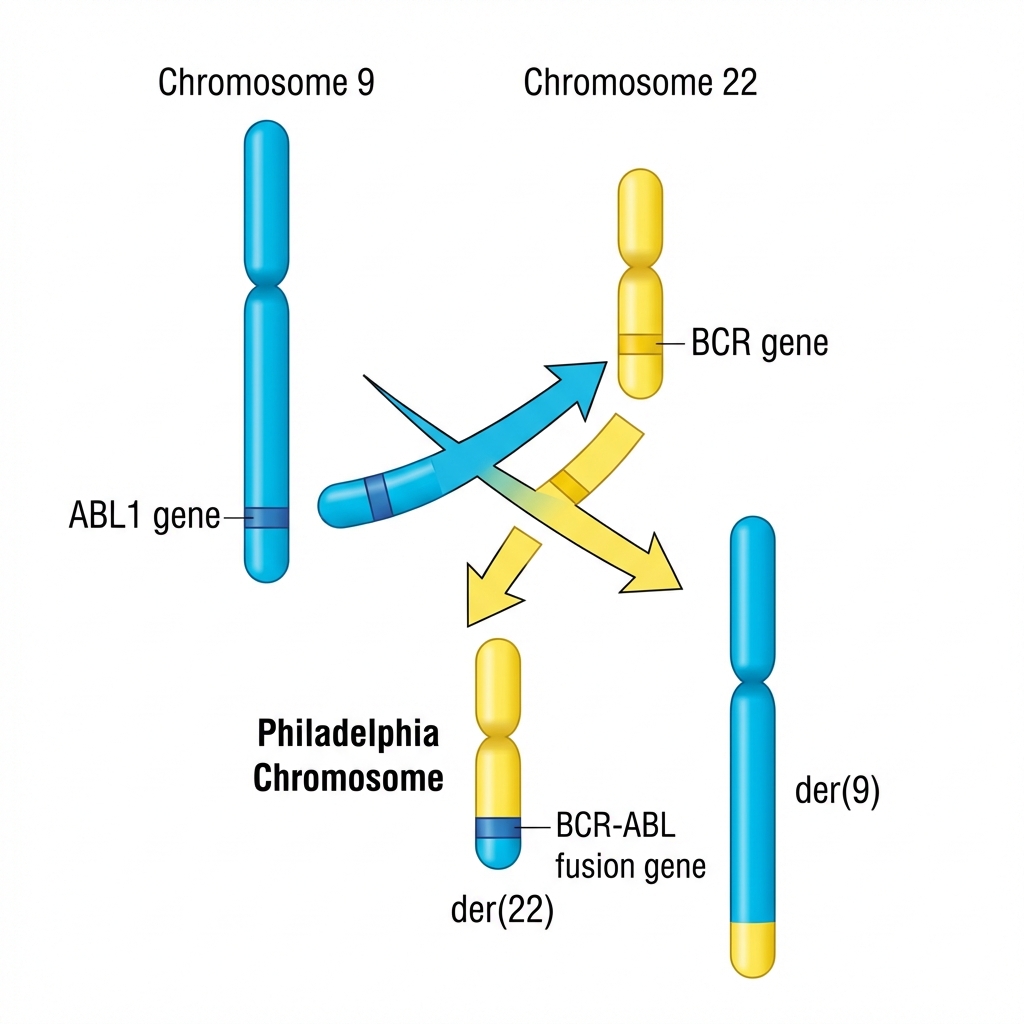
Figure 1: The reciprocal translocation between chromosomes 9 and 22 that creates the BCR-ABL1 fusion gene.
How It Forms
The Philadelphia chromosome results from a reciprocal translocation between chromosomes 9 and 22 — written as t(9;22)(q34.1;q11.2):
Step 1: The Break
The ABL1 gene on chromosome 9 and the BCR gene on chromosome 22 both break at specific locations. ABL1 normally encodes a tightly regulated tyrosine kinase involved in cell growth signaling.
Step 2: The Swap
The broken segments swap positions: the tail end of ABL1 moves to chromosome 22 and fuses with BCR. This creates the shortened Philadelphia chromosome (derivative chromosome 22) carrying the novel BCR-ABL1 fusion gene.
Step 3: The Oncogene
The BCR-ABL1 fusion produces a constitutively active tyrosine kinase — it is permanently "switched on." This drives uncontrolled proliferation of myeloid cells, blocks apoptosis, and disrupts normal cell adhesion in the bone marrow.
🔬 BCR-ABL1 Protein Variants
The breakpoint within the BCR gene determines which fusion protein is produced: p210 (major breakpoint, M-bcr) is found in virtually all CML cases, p190 (minor breakpoint, m-bcr) is more common in Ph+ ALL, and p230 (micro breakpoint) is rare and associated with a more indolent course. The p210 protein has stronger kinase activity than normal ABL1, activating multiple downstream pathways: RAS/MAPK, PI3K/AKT, and JAK/STAT.
📊 The Three Phases of CML
CML is unique among leukemias in having a predictable, stepwise progression through three distinct phases. Without treatment, CML inevitably progresses from chronic to blast phase. With modern TKI therapy, the vast majority of patients remain in chronic phase indefinitely.
Chronic Phase (CP) — ~85-90% at Diagnosis
The earliest and most treatable phase. The disease is relatively stable — myeloid cells still differentiate and function, but they are produced in excess.
- • Blasts <10% in blood and marrow
- • Elevated WBC (often 50,000-200,000+)
- • Expanded granulocyte pool — "left shift" with all stages visible
- • Basophilia and eosinophilia common
- • Splenomegaly in many patients
With TKI Therapy:
~95% of chronic phase patients achieve complete cytogenetic response (no Philadelphia chromosome detectable). Many achieve deep molecular response(BCR-ABL1 ≤0.01%), and some can even discontinue therapy (treatment-free remission).
Accelerated Phase (AP)
A transitional phase indicating the disease is becoming more aggressive. Additional genetic mutations accumulate, and the CML clone begins losing the ability to differentiate normally.
- • Blasts 10-19% in blood or marrow
- • Basophils ≥20% in blood
- • Persistent thrombocytopenia or thrombocytosis
- • Increasing spleen size despite treatment
- • Additional cytogenetic abnormalities ("clonal evolution")
Treatment Implications:
Requires a change in TKI (often to a more potent 2nd or 3rd generation agent). Allogeneic stem cell transplant may be considered. Response to TKIs is still possible but less durable.
Blast Phase (BP) — "Blast Crisis"
The most advanced phase — CML has effectively transformed into an acute leukemia. Blast phase can be myeloid (~60-70%) or lymphoid (~20-30%), which affects treatment choice.
- • Blasts ≥20% in blood or marrow
- • Extramedullary blast proliferation (chloromas)
- • Behaves like acute leukemia (AML or ALL)
- • Multiple additional genetic mutations present
Prognosis:
The most challenging phase to treat. Requires AML- or ALL-type chemotherapy plus TKI. Allogeneic transplant is the only potentially curative option. Lymphoid blast crisis generally has better outcomes than myeloid blast crisis.
🩸 How CML Affects Blood Production
Unlike AML, where immature blasts dominate, CML in chronic phase produces an overabundance of maturing granulocytes. The cells still differentiate — they just don't stop proliferating. This creates a characteristic blood picture that experienced hematologists can recognize at a glance.
📈 The Characteristic Blood Picture
CML is often discovered incidentally via routine blood work. The complete blood count (CBC) shows dramatically elevated white blood cell counts — often 50,000-300,000/μL (normal: 4,500-11,000). The differential reveals a "left shift" with all stages of granulocyte maturation visible: myeloblasts, promyelocytes, myelocytes, metamyelocytes, bands, and mature neutrophils. This orderly maturation pattern distinguishes CML from AML.
🔬 Basophilia — A Hallmark
Elevated basophils are a distinctive feature of CML and relatively rare in other conditions. Rising basophil counts on therapy may signal disease progression. Eosinophilia is also common. Together with the left shift, these findings are nearly pathognomonic for CML.
🫀 Splenomegaly
The spleen enlarges as it filters the massive excess of circulating granulocytes. Some patients present with massive splenomegaly — a spleen extending well below the navel — causing left-sided abdominal pain, early satiety, and weight loss. Splenic infarction can occur. Spleen size typically normalizes with successful TKI therapy.
⚡ Leukostasis
When WBC counts exceed 100,000/μL, there is a risk of leukostasis — white cells sludging in small blood vessels of the lungs and brain. Symptoms include shortness of breath, confusion, and visual changes. This is a medical emergency requiring immediate treatment with hydroxyurea and/or leukapheresis to rapidly reduce the white cell count.
💊 The TKI Revolution — Cancer's Greatest Success Story
The development of imatinib (Gleevec®) in 2001 transformed CML from a fatal disease (median survival 3-5 years) to a manageable chronic condition with near-normal life expectancy. It is widely considered the greatest success story in targeted cancer therapy and the model for precision medicine.
Generations of TKIs
Imatinib (Gleevec®)
The original BCR-ABL1 inhibitor. Binds the ATP-binding pocket of the ABL1 kinase in its inactive conformation, blocking its enzymatic activity. Approved in 2001 after landmark clinical trials showed ~95% complete cytogenetic response in chronic phase CML. Now available as a generic medication.
The IRIS trial (2003-present) showed that patients who achieved optimal response to imatinib have near-normal life expectancy — a truly transformative result.
Dasatinib (Sprycel®) & Nilotinib (Tasigna®)
Developed to overcome imatinib resistance and achieve faster, deeper responses. Dasatinib is ~325x more potent than imatinib in vitro and also inhibits SRC family kinases. It can cross the blood-brain barrier. Nilotinibis more selective for BCR-ABL1 and achieves deeper molecular responses faster.
Both can be used as frontline therapy or after imatinib failure. Side effect profiles differ: dasatinib (pleural effusions), nilotinib (cardiovascular events, metabolic effects).
Bosutinib (Bosulif®)
Another 2nd-generation TKI with activity against most BCR-ABL1 mutations. Approved for both newly diagnosed and resistant/intolerant CML. Primarily causes GI side effects (diarrhea) rather than the cardiovascular or pulmonary effects of other TKIs.
Ponatinib (Iclusig®)
The only TKI effective against the notoriously resistant T315I "gatekeeper" mutation — a single amino acid change that blocks 1st and 2nd generation TKIs from binding. Ponatinib was designed specifically to overcome this mutation using a carbon-carbon triple bond that bypasses the bulky isoleucine residue.
Carries a boxed warning for arterial thrombotic events — dose optimization strategies are used to minimize vascular risk while maintaining efficacy.
Asciminib (Scemblix®)
A revolutionary STAMP (Specifically Targeting the ABL Myristoyl Pocket)inhibitor — it works by a completely different mechanism than all other TKIs. Instead of blocking the ATP-binding site, asciminib targets the myristoyl pocket on ABL1, an allosteric regulatory site. This means it can overcome virtually all ATP-binding site mutations, including T315I when combined with a conventional TKI.
The ASC4FIRST trial showed asciminib superiority over investigator-selected TKIs as frontline therapy, potentially establishing it as a new standard of care.
📋 Monitoring & Response Milestones
CML monitoring is unusually precise compared to other cancers. The BCR-ABL1 transcript level can be measured with extreme sensitivity using quantitative PCR (qPCR), allowing clinicians to track the disease on the International Scale (IS).
Response Levels
| Response | BCR-ABL1 (IS) | Meaning |
|---|---|---|
| CHR | — | Complete Hematologic Response — normal blood counts |
| CCyR | ~1% (≤1%) | Complete Cytogenetic Response — no Ph+ cells on karyotype |
| MMR (MR3) | ≤0.1% | Major Molecular Response — key milestone; 3-log reduction |
| MR4 | ≤0.01% | Deep Molecular Response — 4-log reduction; approaching TFR eligibility |
| MR4.5 | ≤0.0032% | 4.5-log reduction — threshold for Treatment-Free Remission (TFR) attempts |
ELN Time-Based Milestones
The European LeukemiaNet (ELN) guidelines set specific response milestones at each time point. Failure to achieve these milestones prompts consideration of a TKI switch:
BCR-ABL1 ≤10%
(and/or Ph+ ≤35%)
BCR-ABL1 ≤1%
(CCyR achieved)
BCR-ABL1 ≤0.1%
(MMR achieved)
BCR-ABL1 ≤0.1%
(Maintain MMR)
🎯 Treatment-Free Remission — Can CML Be "Cured"?
One of the most exciting developments in CML is the possibility of treatment-free remission (TFR) — safely stopping TKI therapy while maintaining undetectable disease levels. This challenges the traditional assumption that CML patients need lifelong therapy.
📋 Eligibility Criteria for TFR
- • At least 3 years of TKI therapy (some guidelines say 5+)
- • Sustained deep molecular response (MR4 or MR4.5) for at least 2 years
- • Chronic phase CML only (no history of accelerated or blast phase)
- • Access to reliable, frequent molecular monitoring (monthly for 6-12 months, then quarterly)
- • Patient understanding and willingness for close follow-up
📊 What Happens After Stopping?
Landmark studies (STIM, EURO-SKI, DESTINY) have shown:
- • ~50% of patients maintain TFR long-term after stopping TKIs
- • Most relapses occur within the first 6 months
- • Virtually all patients who relapse respond again when TKI is restarted
- • ~20-30% experience "TKI withdrawal syndrome" — musculoskeletal pain that resolves over weeks
- • A second TFR attempt is possible for some patients who relapse and re-achieve deep response
🔬 Why TFR Works: Immune Surveillance
Current evidence suggests that patients who maintain TFR have effective immune surveillanceagainst residual CML cells. NK cells and T-cells appear to keep the small remaining CML clone in check. Research into boosting this immune response (e.g., interferon-α, immune checkpoint approaches) may expand the proportion of patients eligible for TFR in the future.
⚡ Resistance Mechanisms & Mutation Testing
While TKIs are remarkably effective, ~20-25% of patients will develop resistance or intolerance to their initial TKI. Understanding resistance mechanisms is key to selecting the right next therapy.
BCR-ABL1 Dependent (Mutations)
Mutations in the ABL1 kinase domain that prevent TKI binding:
- • T315I — "gatekeeper" mutation; resistant to all TKIs except ponatinib and asciminib
- • E255K/V, Y253H — P-loop mutations; often resistant to imatinib
- • F317L — resistant to dasatinib specifically
- • Compound mutations — two mutations on the same molecule; increasingly challenging
BCR-ABL1 Independent
Resistance mechanisms not involving the target itself:
- • Drug efflux — increased expression of MDR1/P-glycoprotein pumps
- • Alternative pathway activation — SRC, LYN, or other kinases bypass BCR-ABL1
- • Clonal evolution — additional genetic changes provide survival advantage
- • Pharmacokinetic factors — poor drug absorption or drug interactions
🧪 ABL1 Kinase Domain Mutation Testing
When a patient loses response to a TKI, ABL1 mutation testing (by Sanger sequencing or next-generation sequencing) is performed to identify the specific resistance mutation. This directly guides TKI selection — for example, T315I requires ponatinib or asciminib, while F317L warrants switching away from dasatinib. This is one of the clearest examples of precision medicinein oncology.
📚 Authoritative CML Resources
These trusted organizations provide comprehensive, up-to-date information about CML:
Blood Cancer United — CML
Comprehensive CML overview, diagnosis, and treatment information.
Visit →LLS — Chronic Myeloid Leukemia
Patient guides, support programs, and financial assistance.
Visit →NCI — CML Treatment (PDQ®)
Detailed treatment information reviewed by oncology experts.
Visit →NCCN — CML Patient Guidelines
Patient-friendly version of the clinical practice guidelines.
Visit →🛠️ Tools & Focused Research
Scientific Literature
Search thousands of PubMed articles curated for Chronic Myeloid Leukemia.
Clinical Trials
Explore actively recruiting clinical trials for this disease group.
View Clinical Trials