
ℹ️ What is Chronic Lymphocytic Leukemia (CLL)?
💊 Primary Treatment Approaches
CLL treatment has shifted to targeted, chemotherapy-free approaches — with many early-stage patients safely monitored without treatment:
🔬 CLL Biology — Mature B-Cells Gone Wrong
Unlike most leukemias where immature cells dominate, CLL is a cancer of mature-appearing B-lymphocytes. These cells look nearly normal under the microscope but have a critical defect: they cannot die. CLL is primarily a disease of failed apoptosisrather than excessive proliferation — the cells accumulate because they resist programmed cell death.
🛡️ The BCL-2 Survival Pathway
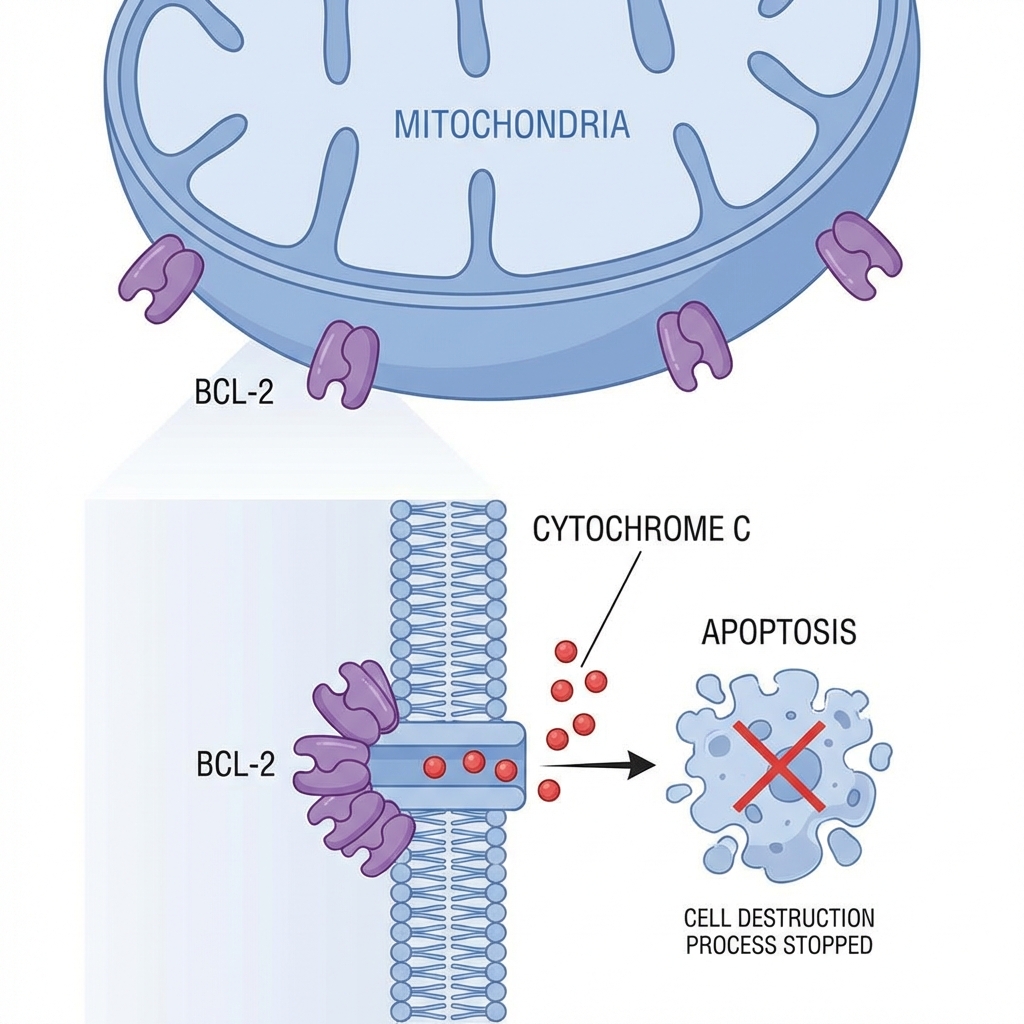
CLL cells massively overexpress BCL-2 — the key anti-apoptotic protein that blocks programmed cell death. This is the fundamental survival mechanism of CLL:
- • BCL-2 prevents release of cytochrome c from mitochondria
- • Blocks activation of the caspase cascade (the cell death machinery)
- • CLL cells have a 100-fold higher BCL-2/BAX ratio than normal lymphocytes
- • This makes venetoclax (a BCL-2 inhibitor) one of the most effective CLL drugs
📡 The B-Cell Receptor (BCR) Signal
CLL cells receive chronic survival signals through their B-cell receptor, which activates critical downstream pathways:
- • BTK (Bruton's Tyrosine Kinase) — the key BCR signaling node; target of ibrutinib, acalabrutinib, zanubrutinib
- • PI3Kδ — promotes survival and homing; target of idelalisib
- • NF-κB activation — anti-apoptotic gene expression
- • Some CLL cells have autonomous BCR signaling — the receptor fires without external stimulation
🔄 The Lymph Node Microenvironment
While CLL cells in the blood are quiescent, the "proliferation centers" within lymph nodes are where CLL actively grows. T-cells, nurse-like cells, and stromal cells in these niches provide pro-survival signals (CD40L, BAFF, IL-4, IL-21) that activate NF-κB and drive CLL cell division. BTK inhibitors work partly by expelling CLL cells from these protective niches into the blood — explaining the characteristic initial lymphocytosis (rising blood count) when starting BTK inhibitor therapy.
📊 CLL vs SLL, Staging & "Watch and Wait"
CLL and Small Lymphocytic Lymphoma (SLL) are the same disease at the cellular and molecular level. The distinction is purely based on where the disease manifests: CLL presents primarily in the blood (≥5,000/μL monoclonal B-cells), while SLL manifests mainly in lymph nodes with fewer circulating cells.
Clinical Staging Systems
Rai Staging (US)
| Stage | Features | Risk |
|---|---|---|
| 0 | Lymphocytosis only | Low |
| I-II | + Lymphadenopathy ± splenomegaly | Intermediate |
| III-IV | Anemia and/or thrombocytopenia | High |
Binet Staging (Europe)
| Stage | Features | Median OS |
|---|---|---|
| A | <3 enlarged areas, normal Hb & platelets | >10 years |
| B | ≥3 enlarged areas | ~7 years |
| C | Anemia and/or thrombocytopenia | ~2-5 years |
⏳ "Watch and Wait" — Active Surveillance
A hallmark of CLL management: most early-stage CLL patients do not need treatment. The iwCLL (international workshop on CLL) criteria require active disease before starting therapy — including progressive cytopenias, massive/progressive lymphadenopathy or splenomegaly, lymphocyte doubling time <6 months, or constitutional symptoms (weight loss, fevers, night sweats). Studies have consistently shown that early treatment of asymptomatic CLL does not improve survival, making "watch and wait" a safe and evidence-based strategy — though patients should have regular monitoring (every 3-12 months).
🧬 Genetics & Prognostic Markers
CLL has a well-defined set of genetic and molecular markers that powerfully predict disease course and treatment response. Modern CLL care requires comprehensive testing before treatment decisions.
FISH Cytogenetics
del(13q) — Isolated
The most common abnormality (~55%). Deletion of 13q14, which includes the miR-15a/16-1 microRNA cluster — regulators of BCL-2 expression. When isolated (no other abnormalities), associated with the best prognosis and slowest progression.
Trisomy 12
Found in ~15% of CLL. Associated with atypical morphology and higher CD20 expression. Generally intermediate-to-favorable prognosis. Often co-occurs with NOTCH1 mutations.
del(11q) — ATM Deletion
Found in ~15-20%. Deletes the ATM gene (DNA damage repair). Associated with bulky lymphadenopathy, younger age, and faster progression. Historically adverse, but BTK inhibitors have significantly improved outcomes in del(11q) CLL.
del(17p) / TP53 Mutation
Found in ~5-10% at diagnosis, higher at relapse. Loss or mutation of TP53 causes chemotherapy resistance — these cells cannot undergo DNA damage-induced apoptosis. Previously associated with very poor outcomes, but BTK inhibitors and venetoclax remain effectivebecause they work through TP53-independent mechanisms. This is the single most important factor determining treatment choice in CLL.
Key Molecular Markers
| Marker | Significance |
|---|---|
| IGHV Mutation Status | Mutated IGHV (~60%): favorable, often indolent, excellent response to time-limited venetoclax-based therapy. Unmutated IGHV (~40%): more aggressive, may need continuous BTK inhibitor therapy. |
| NOTCH1 Mutations | ~10-15%. Associated with Richter's transformation risk and possible reduced benefit from anti-CD20 antibodies. |
| SF3B1 Mutations | ~15%. RNA splicing gene. Associated with intermediate prognosis and fludarabine resistance. May indicate need for novel agents. |
| Complex Karyotype | ≥3 abnormalities. Increasingly recognized as an independent adverse factor, especially ≥5 abnormalities. Contributes to prognostic scoring. |
💊 The Treatment Revolution — Chemotherapy-Free Era
CLL treatment has undergone a complete paradigm shift. Chemotherapy-based regimens (FCR, BR) that were standard until ~2015 have been largely replaced by targeted therapies with dramatically better outcomes and tolerability. Most CLL patients today never receive chemotherapy.
🎯 BTK Inhibitors — Continuous Therapy
Ibrutinib (Imbruvica®) — 1st Generation
The first oral BTK inhibitor (approved 2014). Irreversibly binds to BTK at the C481 residue. Revolutionized CLL treatment but causes off-target effects: atrial fibrillation (~10-15%), hypertension, bleeding, and arthralgias — leading to ~20% discontinuation rates.
Acalabrutinib (Calquence®) — 2nd Generation
More selective for BTK with fewer off-target effects. Lower rates of atrial fibrillation and bleeding. The ELEVATE-RR trial showed non-inferior efficacy to ibrutinib with better tolerability. Taken twice daily.
Zanubrutinib (Brukinsa®) — 2nd Generation
Designed for sustained, complete BTK occupancy. The ALPINE trial demonstratedsuperiority over ibrutinib in relapsed CLL with lower cardiac toxicity. Increasingly used as the preferred BTK inhibitor.
Pirtobrutinib (Jaypirca®) — Non-Covalent BTKi
A reversible (non-covalent) BTK inhibitor effective against the C481S resistance mutation that causes failure of covalent BTK inhibitors. Provides a critical option for patients who have progressed on ibrutinib/acalabrutinib/zanubrutinib.
💥 Venetoclax — Time-Limited Therapy
A BCL-2 inhibitor that directly targets CLL's survival mechanism by blocking the anti-apoptotic BCL-2 protein. Combined with obinutuzumab (anti-CD20), it enables a fixed-duration, 12-month treatment — after which patients stop all therapy. Key considerations:
- • Requires a 5-week dose ramp-up to prevent tumor lysis syndrome (TLS)
- • Achieves undetectable MRD in ~75% of patients — the deepest responses in CLL
- • Particularly effective in mutated IGHV CLL (very long remissions)
- • Can be re-used at relapse if prior remission was long
🔮 The BTKi + Venetoclax Combination (Fixed Duration)
The most exciting frontier in CLL: combining a BTK inhibitor with venetoclax for fixed- duration, chemotherapy-free treatment. Trials like CLL13, GLOW, and MAJESTY show unprecedented rates of undetectable MRD (>80%) with 1-2 years of treatment. This approach aims to achieve deep remissions that may last years — potentially moving CLL toward a functionally curable disease for many patients.
⚠️ Complications & Special Situations
CLL causes unique complications beyond cytopenias — particularly immune dysfunction and the risk of high-grade transformation.
🔄 Richter's Transformation
~2-10% of CLL patients develop Richter's transformation — conversion to an aggressive lymphoma, usually diffuse large B-cell lymphoma (DLBCL). Presents with rapidly enlarging lymph nodes, B-symptoms, and elevated LDH. Prognosis is poor (median survival 6-12 months). Diagnosis requires lymph node biopsy. PET-CT can help identify the transformed site. Risk factors include NOTCH1 mutations, unmutated IGHV, and del(17p).
🛡️ Immune Dysfunction
CLL causes profound immunosuppression through multiple mechanisms: hypogammaglobulinemia (low antibody levels), impaired T-cell function, and complement deficiency. Patients are highly susceptible to infections (the most common cause of death) — particularly bacterial pneumonia, herpes zoster reactivation, and opportunistic infections. IVIG supplementation helps patients with recurrent infections.
🩸 Autoimmune Cytopenias
~5-10% of CLL patients develop autoimmune hemolytic anemia (AIHA) or immune thrombocytopenia (ITP). The CLL cells stimulate auto-reactive antibody production that destroys the patient's own red cells or platelets. This is treated with steroids and often responds to CLL-directed therapy — important to distinguish from CLL-related marrow failure, which has different treatment implications.
🏥 Second Cancers
CLL patients have a 2-7x increased risk of developing other cancers, particularly skin cancers (melanoma and non-melanoma), lung cancer, and other hematologic malignancies. This is partly due to immune surveillance failure and partly treatment-related. Regular cancer screening is especially important in CLL patients.
🎯 MRD Testing & The Future of CLL
Minimal Residual Disease (MRD) testing has become central to CLL management, particularly with time-limited therapies. Achieving undetectable MRD (uMRD)— fewer than 1 CLL cell per 10,000 leukocytes — correlates strongly with prolonged progression-free survival.
🔬 MRD Testing Methods
- • Flow cytometry (10⁻⁴ sensitivity) — most commonly used; measures CLL- specific surface markers
- • ASO-PCR / NGS (10⁻⁵ to 10⁻⁶) — higher sensitivity; tracks the specific IGHV gene rearrangement of each patient's CLL clone
- • Can be measured in blood or bone marrow — blood MRD is becoming standard for convenience
🔮 Emerging Approaches
- • CAR T-cell therapy (lisocabtagene maraleucel) — under investigation for relapsed/refractory CLL; not yet standard
- • Bispecific antibodies (epcoritamab, glofitamab) — CD20×CD3 bispecifics showing promise in Richter's transformation
- • MRD-guided treatment duration — stopping therapy when uMRD is achieved rather than a fixed number of cycles
- • Triple combinations (BTKi + venetoclax + anti-CD20) for deepest possible responses
📚 Authoritative CLL Resources
These trusted organizations provide comprehensive, up-to-date information about CLL:
Blood Cancer United — CLL
Comprehensive CLL/SLL overview, diagnosis, and treatment information.
Visit →CLL Society
Patient-founded organization with expert webinars, specialist directory, and community support.
Visit →NCI — CLL Treatment (PDQ®)
Detailed treatment information reviewed by oncology experts.
Visit →LLS — Chronic Lymphocytic Leukemia
Patient guides, caregiver support, and financial assistance programs.
Visit →🛠️ Tools & Focused Research
Scientific Literature
Search thousands of PubMed articles curated for Chronic Lymphocytic Leukemia.
Clinical Trials
Explore actively recruiting clinical trials for this disease group.
View Clinical Trials